

9 Essential Dave Ramsey Tips for 2023
Ramsey is the man with the financial plan.
You know his strategy: spend less on yourself, and put that money towards building your emergency fund and becoming debt free.
So how are we going to make his plan easier for you?
We want to help you lower your bills and increase your income.
And we’ve got tips right here to help you make it happen.
Don’t let financial insecurity be your destiny.
Make simple changes to gain control of your finances and give you a peace you didn’t think possible.
These Dave Ramsey Tips Will Lead You to Financial Freedom
Dave Ramsey has taught people how to get control of their finances for decades.
While some of his teachings can be a little controversial, nearly 2 millions families have found financial peace.
What are you waiting for?
1. Create a Spending Plan

There’s no getting around it, if you want to have control over your finances you need to have a budget.
Dave Ramsey suggests a zero-based budget in which you give every dollar a “name.”
This means that every dollar that comes into your home is assigned a purpose.
With a zero-based budget you write down the amount of money you will receive in for the month and figure out where it will be spent.
This includes bills, savings, discretionary items like restaurants, entertainment, Starbucks and clothing, and whatever else you spend money for.
When you subtract your expenses from your income, you should be at zero.
If you have money left over on paper, then figure out where you want to put it (like toward debt or savings or Christmas).
If you have a negative number, then you’re going to have to make some cuts.
2. Stick to the Budget

Creating a budget and sticking to it are two different things.
You worked hard to create a budget, don’t ruin it by not following it.
Everyone in your family needs to be on the same page.
Here’s a tip on how to make it easier to stick to your budget: create a budget you want to stick to.
Think of every dollar you spend as an opportunity to make your life better.
You have a mortgage; your home makes your life better.
Your power bill makes your life better.
But do you really need to pay for Hulu, Netflix, HBO, and Disney+ at the same time?
Is that making your life better?
Cut spending on the expenses that don’t make your life better.
3. Protect the Four Walls of Home

What happens when you don’t make enough money to cover all your expenses?
You make sure to take care of the most important things — the four walls.
Ramsey describes the four walls as:
- Food: Make sure food is on the table. (Also see: 7 Tips to Save on Groceries)
- Utilities: Keep the lights on. (Also see: Save on Utilities with these Top Energy Saving Amazon Products)
- Rent/mortgage: Maintain a roof over your head.
- Transportation: You will need to find a way to work.
4. Don’t Go Further into Debt

While we don’t share Dave Ramsey’s same view of credit cards, that doesn’t mean his message is wrong.
Credit cards are dangerous!
If you struggle with credit card debt, take scissors to them today. Do not wait.
Dave Ramsey’s baby steps say to put $1,000 in the bank, and then put everything you can towards your debt.
This is sound advice.
High interest rates are draining your finances.
Ramsey says to pay down debt using the debt snowball.
5. Have an Emergency Fund
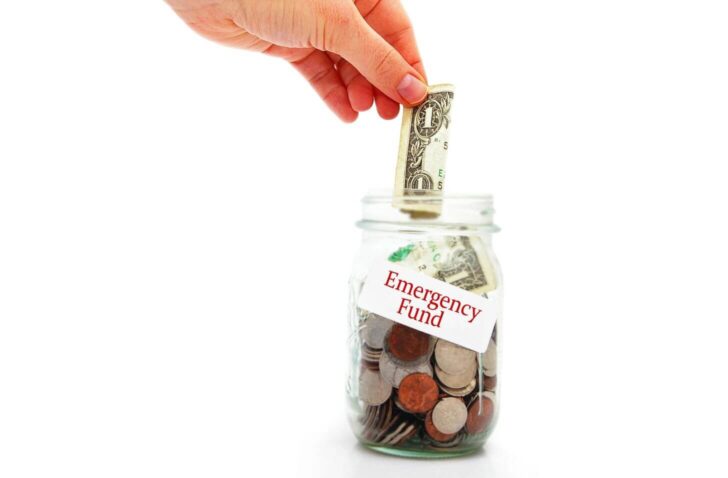
Dave Ramsey’s first step of his “7 baby steps” for financial peace is getting $1,000 into an emergency fund.
That money is strictly for emergencies.
If you budget you can plan for irregular expenses like holidays and birthdays so that the emergency fund is only used for emergencies.
He suggests keeping this money in a different account than where you normally bank, so it is that much harder to get to, unless you have a real emergency.
6. Use Cash

Did you know shoppers who pay with a credit card spend more than those who use cash.
It’s easier to overspend with plastic than if you are paying with cold, hard cash because you only have so much money in your pocket.
Dave Ramsey recommends using the cash envelope method.
As long as your envelope has cash in it, you can spend it.
But when it is gone, it’s gone.
7. Attack Debt

If you pay the minimum on your debt it will be nearly impossible to pay it off.
Attack your debt as quickly as possible.
Dave Ramsey suggests the snowball method.
You make minimum payments on everything but the smallest debt.
Pay as much as possible on the smallest debt to knock it out fast.
Take all of the money you paid on the small debt and apply it to the next one.
Keep rolling that money over … like a snowball.
8. Avoid Temptation

If you have a weakness for spending money on “deals” when you shop, then limit the number of times you shop.
If you tend to overspend on groceries when you are hungry, then eat before you go.
Learn what your weaknesses are and then avoid places that may cause you to slip.
9. Give

Giving plays an important part of Dave Ramsey’s budgeting process.
Whether it is to a church, a charitable organization or to someone who has need, make giving a part of your financial routine.
Nothing feels better than knowing you had a hand in helping someone else.
Up Next: 11 Habits of Debt-Free Families

Save Money At Your Favorite Stores:
Want to save these tips for later? Click here to pin the post!
Be sure to follow us on Pinterest for more money saving strategies!
You May Also Like...






About the author Wendi Warren
Wendi Warren is licensed professional clinical counselor, a certified human resources professional, a digital marketer, and founder of Wendi’s Weekend Trips & Whatnot blog. She and her husband, Bobby, live in Wooster, Ohio, with their pets. In her spare time, she freelances for Wooster Media Group LLC.



I have been following Dave’s financial advice for 20years! It works! We’re paying off our house in1 more year! I’ve also preached to my kids and nieces and nephews about his strategies! I can’t say enough about Dave Ramsey, he’s the best financial guru!
Always live like you are poor cos one day you could well be – according to ancient Chinese Proverb.
I’m blessed with your words of encouragement thank you
so much information. thanks for the information. and a great post.
I know we can’t predict the future. But how do you feel about the deal that is going on now with the no cash . With signs on some business stores stating debit or credit only. I followed your plan and I use cash a lot. What do you about the coin shortage? I would like to know how you feel.
Thanks in advance
With the envelope system, your budget keeps track of itself. When the cash in your grocery envelope is gone, it’s gone. But when you buy groceries with a debit card, you have to use a budgeting app to track your spending so that you don’t overspend. Personally, I recommend switching to a debit card and logging your expenses in a budgeting app. This will help you get better at tracking your money and spending with plastic. Then once you are in complete control of your spending (you spend less than you earn and your money is growing every month), try using a rewards credit card. As long as you pay off your statement balance in full every month (i.e. stick to your budget), you will never go into debt. You will never pay a dime in interest or late fees. Instead you will save hundreds, if not thousands, of dollars every year thanks to your card’s cash back program. Hope this helps.
We, have been using a credit card,that gives you bonus
point, i pay everything with it ,i pay it as soon as i get home,that works Well for us,